

Posts Tagged ‘beginner golf lessons’
7 Signs You Need Golf Lessons Instead of Another YouTube Video

I’ll be honest with you.
I’ve watched golfers spend entire winters binge-watching swing tips online only to show up in spring hitting it the same way they did in October. Some of that content is genuinely good.
But there’s something a screen simply cannot do: watch you.
- It doesn’t know that you tend to rush your transition when you’re nervous.
- It can’t see that your weight never actually shifts the way you think it does.
- It can’t feel the hesitation in your tempo when you’re standing over a tight lie.
Most golfers reach a point where the videos stop helping; they just don’t always know when that happens. Here are 7 signs you might already be there.
Sign #1: You Keep Fixing the Wrong Thing
You found a video that cured your slice. It worked. For a while.
Then it came back. You found another fix. That worked too, for about two weeks.
The problem isn’t your commitment. It’s that you’re working backwards from the ball flight instead of forwards from the cause.
A recurring fault almost always originates somewhere earlier in the swing than where you feel it. And without someone watching your full motion in real time, you’ll keep landing on the symptom and missing the source entirely.
What’s usually happening:
- The fault triggers before the moment you’re focused on
- Ball flight tells you what went wrong, not why
- Patching the same problem repeatedly means the root cause is still there, untouched
Sign #2: You Know What’s Wrong; Your Body Just Won’t Listen

This is a different problem, and it’s one I hear constantly at the coaching tee.
“I know I’m coming over the top. I just can’t stop it.”
You’ve already done the diagnostic work. You know exactly what the fault is. But every time you step up to the ball, the old movement takes over.
That’s not a knowledge gap. That’s a motor pattern problem.
Your body has repeated the wrong movement so many times that it now feels correct.
And feeling correct is exactly what you’re up against.
No video can recalibrate that. What changes a motor pattern is structured repetition with live feedback, someone watching in real time, interrupting the fault before it completes, and helping your body learn what right actually feels like.
That’s the difference between understanding a fix and actually making it stick.
Sign #3: Your Score Has Been the Same for a Full Season (or More)
You’re putting in the work. Range sessions, drills, and new grips, but the same number keeps showing up on your scorecard.
Rarely is it just a swing problem in isolation. More often, it’s a few things quietly working against each other at the same time, and that’s exactly what video instruction isn’t built to untangle:
- Swing inconsistency under pressure – what works on the range doesn’t hold up on the course
- Decision-making – the wrong shot selection erases good ball-striking
- Mental routine – no consistent process for resetting between holes
- Course management – playing the wrong targets for your current game
Structured golf lessons address all of these in context. A video can only answer one question, but a coach watches the whole picture.
Sign #4: You’re a Beginner Who Started Learning from Videos
I understand why: lessons cost money, and videos are free. It feels like a reasonable place to start.
What nobody mentions when you’re starting.
Beginners form habits at an extraordinary speed.
Every swing you take is being encoded into muscle memory, correct or not. Six months of practicing a slightly wrong grip, or a setup you approximated from a phone screen, means six months of ingraining something that will eventually need to be unlearned.
And unlearning is significantly harder than learning.
The golfers I’ve worked with who come in after months of self-teaching, the first job, almost always, is dismantling something they’ve practiced hundreds of times.
That takes far longer than building it right from the start would have.
If you’re just getting into the game, even two or three early beginner golf lessons will save you years of corrective work later. Build the foundation once. Get it right.
Early habits are the hardest thing to undo; I’ve seen that at every level of this game. If you’re just starting, it’s worth getting the fundamentals looked at before they set.
Sign #5: Your Swing Works on the Range, But Falls Apart on the Course
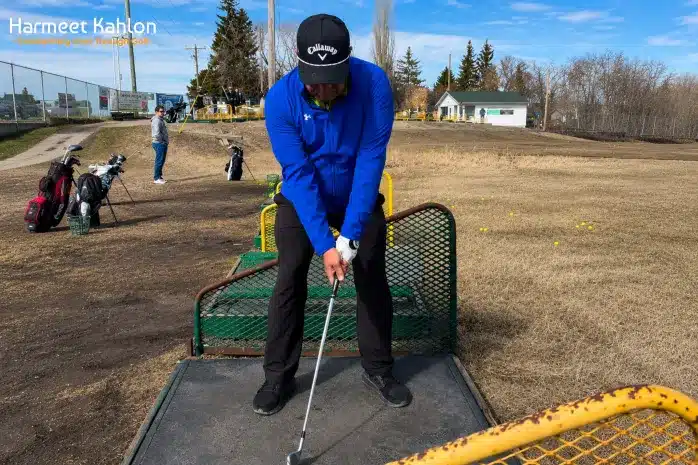
This one is a different problem.
You’re not struggling to diagnose the problem. You’re not fighting a stubborn movement. Your swing genuinely works; you’ve grooved it, and on the range, it holds up.
Then you walk onto the first tee at one of your local golf courses, and it’s a different sport entirely.
When I work with someone dealing with this, I don’t go straight to their swing. I watch everything around it first:
- How ball flight changes under pressure versus in practice
- Whether short game decisions match their actual skill level
- What the pre-shot routine looks like when a shot actually matters
- How they think through targets and shot shapes on the course
Nine times out of ten, it’s one or two things outside the swing creating the collapse. Fix those, and the technique they’ve already built starts showing up where it counts.
Sign #6: You’ve Searched “Golf Lessons Near Me” But Still Haven’t Booked
This is a quiet one, but it’s real.
If you’ve been searching for golf lessons near me and still haven’t committed, something in your game has already told you you’ve hit a wall. You’re just not sure if a lesson will actually change anything.
Most people I work with say the same thing after their first session: they wish they’d come in sooner. Not because anything dramatic happened, but because they finally had a clear picture of what they were actually working with. That clarity alone changes how you practice, how you play, and honestly, how much you enjoy the game.
Sign #7: You’ve Played for Years and Never Had a Single Lesson
There’s a version of this game most recreational golfers never quite reach, not because they lack ability, but because nobody ever showed them what they were actually working with.
A player who’s figured out their natural shot shape, knows which club they genuinely trust under pressure, and has a pre-shot routine that doesn’t fall apart on the course, that’s a different experience of golf entirely.
That’s what occasional private golf lessons tend to unlock:
- A clearer picture of your actual tendencies, not just your bad days
- Shot decisions that come from self-knowledge, not guesswork
- A routine that holds up when the round starts to matter
- More consistent decision-making from the tee on holes that punish mistakes
The handicap might not change overnight. But the way the game feels? That shifts pretty quickly.
One Thing I’ve Learned Over 35 Years of Global Experience Playing Golf
The golfers who improve the fastest aren’t always the most talented ones in the group.
They’re the ones who stop guessing at their own game and start actually understanding it.
They stop cycling through fixes. They start working on the right thing. And most of them got there because someone finally watched them play and told them honestly what they were seeing.
If any of this sounds like the last six months of your game, you’re probably not missing information. You’re missing a second pair of eyes.
Beginner Golf Lessons: Avoid These 5 Common Golf Mistakes

Starting golf is exciting. But let’s be honest, it’s also confusing. The ball goes left when you want it to go right. Your shots feel inconsistent, and no matter how hard you try, nothing seems to click.
Here’s what I’ve noticed after years of teaching: almost every beginner is struggling with the same things. Not because they’re bad at the game, but because nobody told them what to actually look for.
I’m Harmeet Kahlon, a PGA of Canada professional and director of golf at Broadmoor Public Golf Course in Sherwood Park. I’ve spent a long time coaching golfers at every level, and these are the five mistakes I see every single week in beginner golf lessons.
Once you understand what’s causing them, they become much easier to fix.
Mistake #1: Gripping the Club Too Tight
Most beginners squeeze the club like they’re trying to crush it. It feels powerful, but it’s actually killing your swing.
A tight grip causes:
- Stiff wrists that can’t move freely
- Loss of swing speed
- Wild, inconsistent shots
The fix is simple: hold the club like you’re holding a tube of toothpaste, firm enough not to drop it and light enough not to squeeze any out.
This is one of the first things we correct in beginner golf lessons at Broadmoor. It makes an immediate difference.
Mistake #2: Ignoring Your Setup
Your swing starts before you even move the club. Where you stand, how far you reach, and where the ball sits relative to your feet: all of this matters.
If you stand too close to the ball, you’ll shank it sideways. Stand too far away, and you’ll lose your balance and top it along the ground.
Most beginners never check their setup at all. They just step up and swing and then wonder why the results are so unpredictable.
Good golf coaching for beginners spends real time on setup. We use the Skillest video analysis so you can actually see what your stance looks like, which changes things fast.
Mistake #3: Swinging Too Hard
Everyone wants distance. That’s totally normal. But swinging harder almost always makes things worse.
When you swing too hard:
- Your timing falls apart
- The clubface twists at impact
- The ball goes sideways or nowhere near your target
Here’s one of the most useful beginner golf tips I give every new student: swing at 70–80% of what feels like full effort. You’ll hit it further, straighter, and more consistently.
We use TrackMan launch monitor technology in lessons so you can see your actual numbers: swing speed, ball speed, and carry distance. Once you see the data, the guesswork stops.
Mistake #4: Neglecting the Short Game
Here’s a stat most beginners don’t know: around 60% of your shots in a round happen within 100 yards of the hole.
Putting. Chipping. Bunker shots. This is where rounds are actually won or lost.
But most beginners spend nearly all their time on the driving range hitting drivers. Then they get on the course and four-putt from six feet and wonder what went wrong.
When you look for golf lessons for beginners, make sure the short game is part of the program from day one. At Broadmoor, every lesson covers the full swing, putting, chipping, and bunker play.
Mistake #5: Trying to Learn Everything on Your Own
YouTube has a lot of great golf content. But YouTube can’t watch you.
It can’t see that your elbow is collapsing mid-backswing. It can’t tell you your club path is off by five degrees. It can’t catch the tiny head movement you’re making right before impact.
When you self-teach, you often practice your mistakes until they become habits. And habits are hard to break.
This is why beginners who take structured lessons improve so much faster than those who figure it out alone. If you’ve searched for golf lessons near me and landed here, you’re already on the right track.
A good coach spots in one session what might take you years to figure out solo.
How Long Does It Take to Learn Golf as a Beginner?
This is one of the first things new golfers ask, and the honest answer is that it depends on how you practice.
Here’s a rough but realistic picture for most beginners:
After 2–3 lessons: The basics of grip, stance, and swing start to feel natural.
After 4–6 lessons: You’ll begin making more consistent contact, gain confidence, and see real progress in your game.
After a full season: You’ll be course-ready, scoring more consistently, and enjoying the game much more.
The biggest thing that slows people down isn’t lack of practice; it’s practicing without feedback. You can put in a lot of time and not make much progress if you don’t know what to adjust.
Beginner Golf Lessons in Sherwood Park

If you’re in the Sherwood Park or Edmonton area and want to work on any of this, I run beginner golf lessons at Broadmoor Public Golf Course year-round, including indoors through the winter.
Every lesson covers the full picture: swing mechanics, putting, chipping, and bunker play. I use video analysis and a TrackMan launch monitor, which eliminates much of the guesswork in understanding what’s actually happening in your swing. No experience needed. No equipment needed. Just show up.
Location: Broadmoor Public Golf Course, 2100 Oak St, Sherwood Park, AB
Call or text: +1 587-597-1999
FAQs
How many lessons do I need as a beginner?
Most beginners feel real improvement within 4–6 sessions. Pair each lesson with some practice, and you’ll progress even faster.
Do I need my own clubs?
No. Equipment is available at Broadmoor, so you can try a beginner golf lesson before spending anything on gear.
Are lessons available in winter?
Yes. Indoor lessons run all year, using a full launch monitor and video technology. Perfect for getting ready before Alberta’s spring season.
Am I too old to start golf?
Not at all. Many of the most enthusiastic students I coach are adults picking up the game in their 40s, 50s, and 60s. Golf is genuinely for everyone.