

Golf Stretching Exercises: A Simple Routine for a Better Swing
Most golfers spend years working on their swing and very little time working on their body. But the truth is, how freely you move has a direct impact on how well you play.
Golf is a rotational sport. Every shot asks your hips, spine and shoulders to work together through a full range of motion and when any one of those areas is stiff, the rest of your body compensates. That’s where poor shots come from. And over time, that’s where injuries come from too.
In amateur golfers, the annual injury rate sits between 15.8% and 40.9% – with the lower back and wrist being the most common problem areas. A consistent routine of golf stretching exercises won’t just help you feel better. It’ll help you swing better, too.
Before We Start – Static vs Dynamic Stretching
There’s one thing worth knowing before you begin. Before a round, use dynamic movements that warm the joints up without reducing muscle tension. After a round, use static holds to restore range of motion. The routine below is best done as a regular off-course habit – three or more times a week rather than immediately before you tee off.
For static stretches, hold each position for 45-90 seconds per side. Research consistently shows that holds under 30 seconds produce minimal tissue change. Go slow, breathe through each stretch and don’t push past the point of discomfort.
6 Golf Stretching Exercises for a Better Swing
1. Hip Flexor Stretch

Your hip flexors are one of the most overlooked areas in golf – especially if you spend most of your day sitting.
Shortened hip flexors tilt the pelvis forward and create compensations throughout the body, affecting your address posture, your ability to clear the hips in the downswing and your follow-through balance.
Kneel on one knee with the other foot forward. Push your hips gently forward until you feel a stretch along the front of your back leg. Keep your back straight and hold for 30 seconds each side.
2. Thoracic Spine Rotation
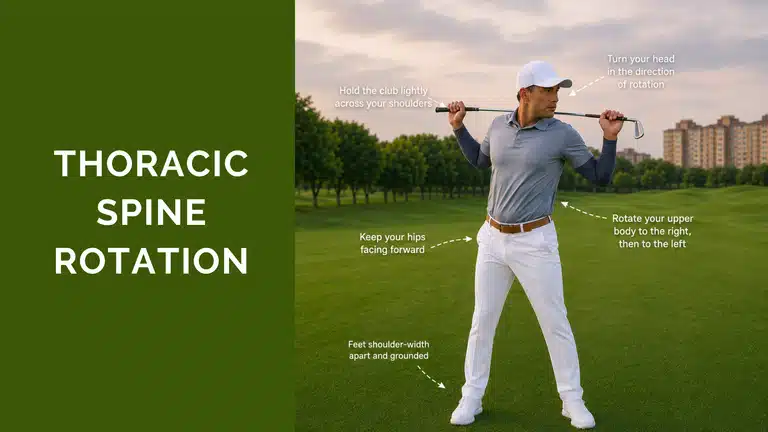
Your mid-back powers your golf swing.
A mobile thoracic spine helps you create a fuller backswing, smoother follow-through, and reduces stress on your lower back.
Stand with your feet shoulder-width apart and place a golf club across your shoulders. Keep your hips as stable as possible while slowly rotating your upper body to the right, return to centre, then rotate to the left. Perform 10–15 controlled repetitions on each side.
3. Hamstring Stretch

Tight hamstrings affect more than just your legs. They pull the pelvis into a position that limits your ability to hinge at the hips properly at address and often contribute to a rounded lower back under load.
Sit on the floor with both legs extended. Reach forward toward your feet without rounding your back. Hold for 45 seconds. You don’t need to touch your toes – just feel the stretch and hold it there. This is one of the most important golf exercises to do consistently, even on days you’re not playing.
4. Chest and Shoulder Stretch

Tight shoulders restrict your backswing more than most golfers realise. This stretch opens up the chest and increases shoulder range of motion – both essential for a full, free swing.
Stand perpendicular to a wall and press the hand closest to it at shoulder height, fingers facing back. Take small steps to turn your chest away from the wall until you feel a stretch through the chest and arm. Hold for 30–60 seconds and repeat on both sides.
If you’re serious about improving your golf stretching routine, this one is non-negotiable.
5. Lying Spinal Twist

This stretch works your thoracic spine and hips at the same time – two of the most important areas for golfers.
Lie on your back with arms out to the sides. Bring your right knee toward your chest, then cross it over your body to the left while keeping your shoulders flat on the floor. Hold for 30 seconds, then switch sides.
It’s simple, requires no equipment and genuinely makes a difference to how freely you rotate through the ball.
6. Wrist Flexion and Extension Stretch

Small area, big impact. The wrist is one of the most common injury sites in golf and one of the most commonly ignored in stretching routines.
Extend one arm in front with your palm down. Use the other hand to gently bend the wrist backward and hold for 20 seconds. Then flip the palm up and gently pull the fingers back toward you. Repeat on both sides.
A flexible wrist gives you a more reliable hinge and a more consistent strike, especially on longer rounds when fatigue sets in.
How Often Should You Do These Stretches?
Aim for at least three times per week – ideally daily. Prioritise depth over speed, and move slowly through each position.
You don’t need a long session every time. Ten to fifteen minutes on the right areas – hips, spine, hamstrings and shoulders – done regularly, will build the kind of flexibility that shows up in your swing over weeks and months. That’s how these exercises for golf actually work. Not overnight, but consistently.
Final Thoughts
Flexibility is one of the simplest things you can improve as a golfer – and one of the most overlooked. A regular golf stretching routine doesn’t just reduce injury risk. It gives your swing more room to work with.
Start with these six exercises. Do them consistently. And notice how much better your body feels by the time you reach the back nine.
Want to improve faster with personalised coaching? Book a lesson with Harmeet Kahlon, PGA certified golf coach with 35 years of experience in Alberta.
Book here → 🌐 harmeetkahlon.com
📞 +1 587-597-1999 ✉️ harmeetkahlon@aol.com ✉️ harmeet.kahlon@strathcona.ca